The Cognavitron — hover for details · click to navigate · double-click for full size
Ecology of Infectious Disease — Agent-Based Models
agent-based-models
epidemiology
computational-ecology
spatial-analysis
Agent-based simulation models for the ecology of infectious disease. Spatial epidemiological dynamics, host movement and contact networks, and disease spread in heterogeneous landscapes.
How does habitat fragmentation affect the spread of infectious disease through a wildlife population? This work was part of the FELIDAE Project (Feline Ecology: Landscapes, Infectious Disease, And Epidemics) at Colorado State University — a multi-investigator program studying cross-species disease transmission, pathogen spillover, and the role of landscape structure in disease dynamics among puma, bobcat, and domestic cat populations across the western US. I contributed as a postdoctoral researcher, developing the spatial epidemiological modeling component.
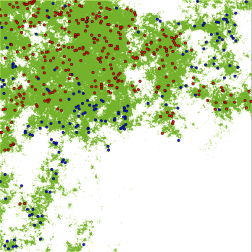
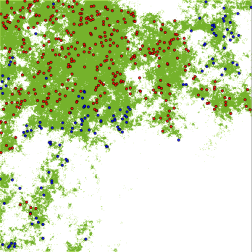
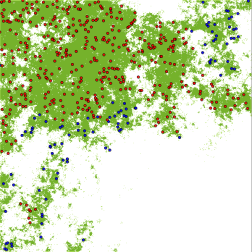
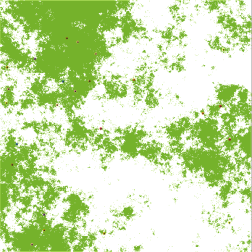
To study how fragmentation shapes disease spread, I built an agent-based model (ABM) in which simulated bobcats move through a spatially explicit landscape, form contact networks based on proximity, and transmit infection to neighbors. The model was motivated by FIV (Feline Immunodeficiency Virus) dynamics — a contact-driven pathogen with low host mortality, making it a tractable system for isolating the landscape → movement → contact → transmission chain without the added complexity of disease-induced population feedbacks. The landscape is derived from actual land cover data — green pixels are habitat, white is the non-habitat matrix. Runs are replicated across many stochastic realizations to characterize the distribution of outcomes.
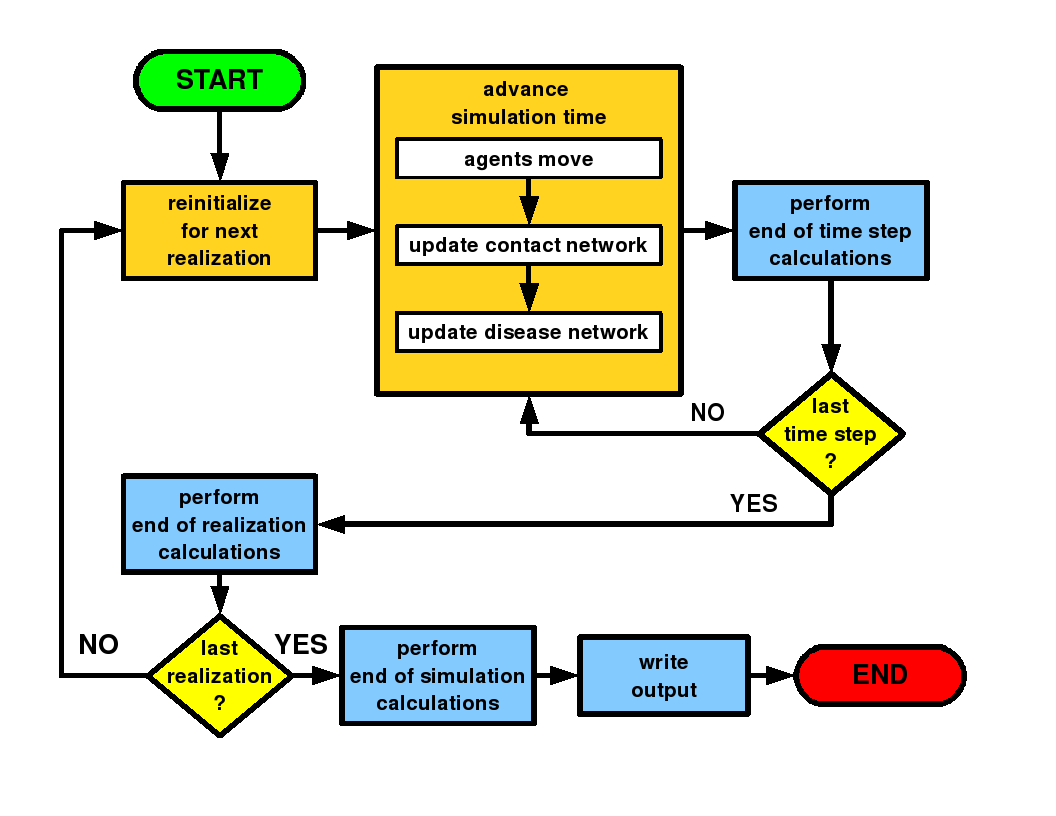
At each time step: agents move, the contact network updates, and the disease network updates. The figure below shows the overall simulation structure.
Simulation Sequences
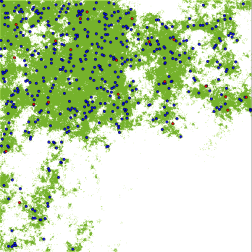
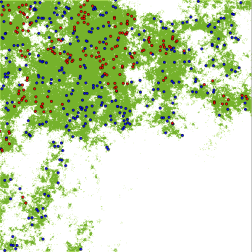
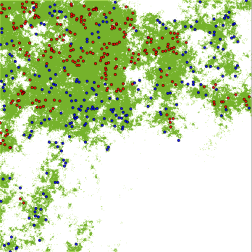
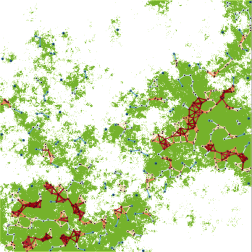
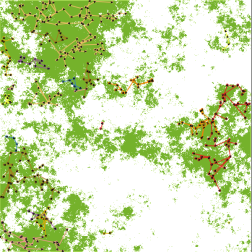
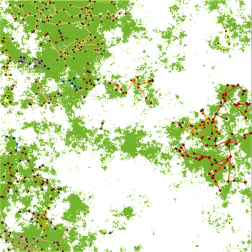
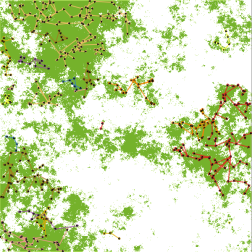
Each sequence below shows six time steps from a single simulation realization, with time increasing left to right then top to bottom. The three sequences are from independent simulation runs, each illustrating a different representation of the model state.
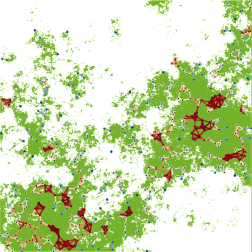
Location and Disease State
Blue = susceptible; red = infected. Infection spreads from a small number of seed individuals; the large connected habitat block saturates quickly while more isolated patches resist longer.
| 1 | 2 | 3 |
 |
 |
 |
| 4 | 5 | 6 |
 |
 |
 |
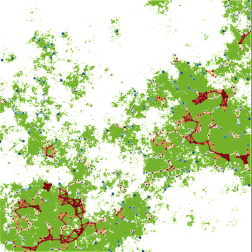
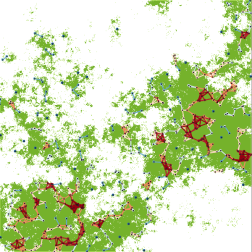
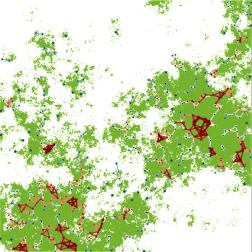
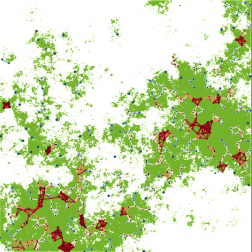
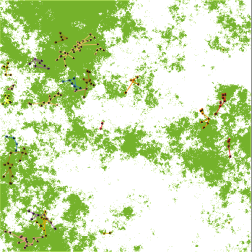
Contact Network
Agents are connected when within proximity of one another — potential transmission links. Node and edge color indicate degree (number of neighbors): dark blue = isolated; orange/red = highly connected. Dense clusters form in habitat patches where animals aggregate.
| 1 | 2 | 3 |
 |
 |
 |
| 4 | 5 | 6 |
 |
 |
 |
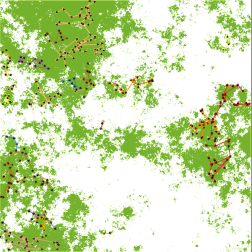
Disease Transmission Network
Each color represents a distinct transmission chain, traceable to a different founding infection. Dense within-patch clusters are connected by occasional long-distance transmissions across the matrix.
| 1 | 2 | 3 |
 |
 |
 |
| 4 | 5 | 6 |
 |
 |
 |
Software
The ABM was implemented in Java with a graphical simulation interface. As a condition of publication, the model code was made available as a software supplement to the Ecosphere paper. The source code is publicly available on GitHub:
github.com/Jeff-Tracey/eeid-abm
Papers
Tracey JA, Bevins SN, VandeWoude S, Crooks KR (2014). An agent-based movement model to assess the impact of landscape fragmentation on disease transmission. Ecosphere 5(9): 1–24. https://doi.org/10.1890/ES13-00376.1
Bevins SN, Tracey JA, Franklin SP, Schmit VL, MacMillan ML, Gage KL, Schriefer ME, Logan KA, Sweanor LL, Alldredge MW, Krumm C, Boyce WM, Vickers W, Riley SPD, Lyren LM, Boydston EE, Fisher RN, Roelke ME, Salman M, Crooks KR, VandeWoude S (2009). Wild Felids as Hosts for Human Plague, Western United States. Emerging Infectious Diseases 15(12): 2021–2024. https://doi.org/10.3201/eid1512.090526