The Cognavitron — hover for details · click to navigate · double-click for full size
Wildlife Cameras
wildlife-cameras
deep-learning
camera-traps
species-detection
field-ecology
Camera trap surveys and deep learning for automated wildlife detection, classification, and monitoring — from field deployment to AI-assisted analysis.
Camera traps generate large volumes of imagery that are time-consuming to review manually. Deep learning models can automate detection and classification, making it practical to run continuous, large-scale wildlife monitoring programs with limited staff.
My work in this area combines field camera deployment with AI pipelines for automated species detection and identification. This includes both the development of detection models and the practical aspects of deploying camera networks in the field — placement, maintenance, data management, and turning images into actionable ecological information.
Individual Identification
Beyond species-level detection, there is growing interest in using camera trap imagery for individual animal identification — recognizing specific individuals from photos, which is otherwise labor-intensive to do manually. This has direct applications for mark-recapture population estimation, behavioral research, and long-term monitoring of animals that carry no physical marks.
I am developing a Siamese network approach to individual ID — a class of deep learning architectures that learn to compare pairs of images and determine whether they show the same individual. The network is trained on matched and mismatched image pairs and learns a similarity metric that generalizes to new individuals not seen during training.
As a development testbed, I have been training on photos of my own cats — a practical choice given ready access to a labeled dataset with known ground truth. The image below shows a sample of matched and mismatched pairs from the training set.
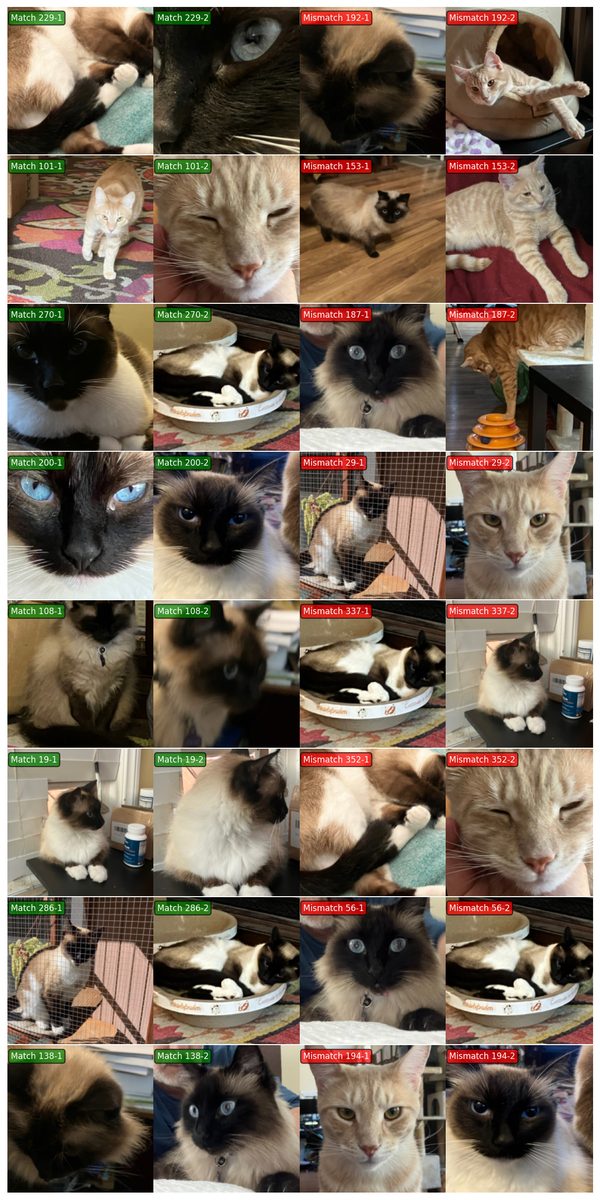
Three of the four cats are part Siamese, which makes this either a fitting coincidence or a conflict of interest, depending on your perspective.
Full details to follow as work develops.